Feature: Am I a Good Man?
Those of us who have been gearing up towards meeting the next incarnation of the Doctor, will no doubt hear ringing in our ears the question “Am I a good man?” An exploration into the moral compass of the Doctor is set to become a major theme of Series Eight. The snippets of information that have been fed through the various forums suggest that the Doctor’s attitudes towards violence and the military will play a key part in determining the answer.
"There should have been another way" - Warriors of the Deep, 1984
In his introductory comments to the Radio Times Tenth Anniversary Doctor Who Special, the then producer Barry Letts mused: “The Doctor is a strongly moral man, who always searches for peaceful solutions.” In recent years various articles have attempted to discredit such an assessment, usually picking out in list form examples of the Doctor’s most questionable actions. From the First Doctor’s attempt to batter the skull of a caveman to the Eleventh angrily leading Kahler Jex to the Gunslinger in A Town Called Mercy, the Doctor has at times needed his companions to intervene and question his morals. Whilst at times he has regretted events (“There should have been another way” – Warriors of the Deep), on other occasions the devastating consequences of his interventions have passed without comment (the destruction of Skaro in Remembrance of the Daleks) or worse still with a flippant remark (eg. “his just desserts” after poisoning Shockeye in The Two Doctors, and “no ‘arm in trying” to Davros after his hand was blown off – Revelation of the Daleks). In The Family Of Blood the Doctor whilst apparently showing initial mercy by choosing to hide rather than confront the family, hands out eternal punishments like an Old Testament god at the story’s denouement. Reminiscent of the fate of Borusa in The Five Doctors this time the Doctor’s power to choose each fate seems all the more chilling.
Letts prefaced his statement about the morality of the Doctor by stating “The Doctor’s appeal is that he’s a superman – and yet he’s fallible.” Could this excuse his occasional violent outbursts or lack of mercy? The fact that the Doctor gets things wrong is rarely a plot device but the exceptions such as Horror of Fang Rock (“I’ve made a terrible mistake”) and The God Complex, do not tend to consider the Doctor’s retaliations as questionable. Over the fifty year history of the show remorse for his actions is not an emotion that readily enters the Doctor’s psyche. We encounter instead an occasional fleeting regret at the side effects of his interventions or distaste for his all too passive stance. There is however, nothing that would prevent him from making disproportionate responses in the future. Towards the end of his regeneration cycle the Doctor considers himself to have grown out of being merciful “I used to have so much mercy.” (School Reunion). At times then the Doctor is violent in an instinctive, reactionary manner because he has been pushed. (eg. “Would you kindly stop referring to me as "the creature", sir. Or I may well become exceedingly hostile!” Carnival of Monsters) . More damningly could the Doctor also be accused of using violent means strategically?
Terrance Dicks, Letts’ right hand man in the 70s suggests in the latest Doctor Who Magazine (September 2014) that the Doctor “….frequently resort(s) to violence – he tries not to, but he very seldom succeeds or it would be a much duller show.” This may well have been true in the Pertwee era where the James Bond like Third Doctor action hero regularly turns to his Venusian aikido skills, but for the most part the Doctor’s use of violence is rare. In The Romans Vicky is amazed to see the first Doctor tackle his would be assassin and he comments that he is something of the expert at 'fisticuffs'.
The Doctor: You know, I am so constantly outwitting the opposition, I tend to forget the delights and satisfaction of the arts, the gentle art of fisticuffs.
Vicki: I realise you're a man of many talents, Doctor, but I didn't know fighting was one of them.
The Doctor: My dear, I am one of the best. Do you know it was I that used to teach the Mountain Mauler of Montana!
"You would not use such a device!" "try me!" - Victory of the Daleks, 2010
The Doctor’s aversion to violence and weaponry is also used to comic effect to counter the danger of dullness that Dicks feared. Frequently the sonic screwdriver is his “weapon” of choice, a staple part of his “armoury” akin to the ancient cynics “staff”. Add to that the Fourth Doctor threatening the Seventeem with the “deadly” jelly baby and the Eleventh using a jammy dodger to fool the paradigm Daleks. Not only are these examples of the Doctor thinking on his feet to get out of a sticky situation, they are also examples of his pooh-poohing of the military and the use of weaponry. There is something of the cynic philosopher about the Doctor, with his distancing from the cultures around him and his self understanding as a “citizen of the universe, and a gentleman to boot”. These ancient pragmatic philosophers abhorred violence and the military, and the use of man made tools and weaponry.
So whilst he occasionally lapses into fits of rage or righteous indignation, the Doctor is not aggressive by default. Neither however is he a “peacekeeper.” Peacekeeping maintains the status quo and justifies and obscures oppression. Regularly the Doctor’s modus operandum is to inspire people to revolt (The Daleks, The Macra Terror, The Sunmakers), even if that means taking up arms against their oppressors. The value of freedom is paramount and violence in such circumstances is seen as the lesser of two evils. Violence in this context is about redressing imbalances of power. The Doctor’s aversion to weapons is that they are usually on the side of the powerful. Those who take up arms must also be prepared to relinquish them as soon as possible, see for instance this important exchange between the Doctor and Taron at the end of Planet of the Daleks:
Taron: Doctor, we'd never have succeeded without all your help. I wish there was some way of thanking you.
The Doctor: As a matter of fact, there is.
Rebec: Yes, Doctor?
The Doctor: Throughout history, you Thals have always been known as one of the most peace-loving races in the galaxy.
Taron: I hope we always will be.
The Doctor: Yes, that's what I mean. When you get back to Skaro, you'll all be national heroes. Everybody'll want to hear about your adventures.
Taron: Of course.
The Doctor: So be careful how you tell that story, will you? Don't glamourise it. Don't make war sound like an exciting and thrilling game.
Taron: [smiles] I understand.
The Doctor: Tell them about the members of your mission that will not be returning. Like Maro, Vaber and Marat. Tell them about the fear. Otherwise your people might relish the idea of war. We don't want that.
In recent years the moral ambiguity of the Doctor has been brought to the fore. In A Good Man Goes To War we discover that even the name The Doctor is translated in other cultures as The Warrior. In the anniversary special we are introduced to the “War Doctor” which sounds like an oxymoron until we quickly learn that he is not really as different from his other incarnations as they would have liked to believe. Just as the Sontaran Strax, though bred for war can become a nurse so too the Doctor can become a warmonger.
To be fair to the War Doctor, passivity can itself be violent. It does not prevent further atrocities and there are times in the Doctor’s past where such cowardice or inaction is morally questionable. It is distressing to watch the Fifth Doctor looking on as the master burns in Planet of Fire, something neither the Third Doctor nor Tenth Doctor would be capable of. The cry “no more” is born out of a frustration of evil getting away with it, but also of the seemingly endless suffering of the innocent.
A Town Called Mercy, 2012
The Doctor has always shown moments of a lack of mercy, lapses in character, understandable considering the evils he has seen. His mercy in itself has created a large degree of guilt, hence in A Town Called Mercy he justifies his attempt to lead Jex to his death by stating: “Every time I negotiate, I try to understand. Well, not today. No. Today I honour the victims first – His, the Master’s, the Daleks’, all the people who died because of my mercy.” Furthermore, he cannot be described ideologically as a pacifist as he is quite prepared to assist others to revolt and is not remorseful if liberation is the outcome. But when it comes to the military, what is the Doctor’s view?
It would appear that the Doctor has a love-hate relationship with both Torchwood and UNIT, the two military organisations whose paths he most regularly crosses. The pattern seems to be that when the Earth is the oppressed as the smaller power in a conflict then he is prepared to be its defender (The Eleventh Hour, World War Three, The Claws of Axos), but when it is authoritarian and the aggressor, the Earth and its military powers are a focus of criticism (eg. The Frontier In Space, The Silurians). Things get more complicated when the smaller power is acting like a terrorist, bypassing diplomatic routes. The Doctor can agree with their aims but not their methods (e.g. The Dinosaur Invasion).
Even in his UNIT bound days the Third Doctor, whilst working for the establishment is frequently critical of the military mindset, joking to Jo “I sometimes think that military intelligence is a contradiction in terms.” Rather than destroying enemies with a show of force his frequent modus operandum, seen especially in the fourth Doctor’s time, is to tap into a weakness of his opponent leading to their “self-inflicted” downfall. But the Doctor is not anti-military, indeed a number of his companions upon leaving join UNIT or Torchwood (or in Rose’s case the equivalent on parallel earth). Sarah Jane Smith is the exception in this respect.
Mercy is in part born out of our experiences of suffering and an awareness of pain. As an alien the Doctor is sometimes shown to lack such sensitivities and as such the withholding of mercy is easier. The Doctor lacks the fear of death and pain that generates the necessary empathy. This is most clearly brought out in Rose when his new companion is aghast at his lack of sympathy for the fate of Mickey and the sight of the plastic Mickey melting in front of her. This excuse could be retconned back to the Colin Baker era where violence was at its most graphic and where the sixth Doctor laughs at the horrific deaths in Vengeance on Varos. In truth the disturbingly graphic scenes in 1985 Who were down to an editorial decision of script editor Eric Saward who wanted to show the realistic consequences of violence. Gary Gillat is harsh in his critique of this trend, pointing out:
"...what (the production team) didn't seem to understand was that Doctor Who has always shown the sobering consequences of violence, that is, the ultimate consequences of terror, pain, retribution, guilt and grief - a cautionary message more suited to its youthful audience and tea-time scheduling. In 1985, it seemed, the 'consequences of violence' were judged to be merely the blood and the viscera, not the anguish or the remorse, and by lingering on this stickiness and mess, much of the series' moral core slipped away, leaving the Doctor looking like little more than a bullying, wise-cracking killer." (in Doctor Who From A to Z, BBC Books 1998, p149)
However, 1985 was not exactly unique in depicting the Doctor as somewhat blase in the face of suffering, Three years earlier even the death of Adric appears to affect Tegan and Nyssa far more so than the Doctor as referenced in the next adventure Timeflight. On the other hand his final word before regenerating is "Adric?" suggesting that he was indeed wrestling with the loss internally. Whilst novelists would later reflect on the consequences of Adric's death in prose (e.g. Goth Opera), the series quickly moved on to business as usual for the Doctor. Despite the touchingly brief scene of the Eleventh Doctor reacting in shock to the news of the Brigadier's death, his response to suffering and loss is generally atypical and a reminder that he is not one of us. The “no more” of the War Doctor must be viewed as an impassioned cry against injustice rather than an emotive response to seeing the pain of others.
Planet of the Spiders, 1974
The motivations of the Doctor’s travels have remained a mystery after 50 years of adventuring. But we can be clear that the Doctor has never been first and foremost a moral crusader. Webber initially conceived of the character as being on a quest to return to his home (hankering after lost traditions), whilst Newman, focusing on the educational opportunities of the show saw him as more of a traveller on a quest for knowledge (yearning for future possibilities). In the 70s Barry Letts took this latter idea further interpreting it as the source of the Doctor’s flaws. Influenced by his Buddhist leanings Letts framed the quest for knowledge as an insatiable greed that ultimately leads to the third Doctor’s downfall on Metebelis 3. "...the very fact that he stole the TARDIS in the first place, to escape and to satisfy his craving, is the key to the flaw that makes him fallible." (quoted in The Handbook, Howe/Walker/Stammers 2005, Telos, page 327) In the New Series it can be argued that the Doctor’s motivation has been to undo the guilt of his actions in The Time War. This places violence and war as key areas to explore in a way that simply wasn’t the case in the classic series. Is the Doctor is now trying to save himself? If so then the ending of Last of The Time Lords can be seen as redemptive - instead of building a weapon of mass destruction, Martha’s journey around the earth is to inspire a band of followers to have faith in the Doctor.
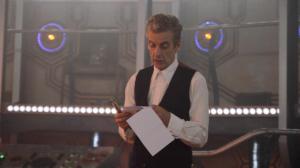
So as we enter the new era of the Twelve Doctor and as the Doctor once again questions his own morality who knows which direction the series will go down. Our quick purview of the past has shown that the poles on the Doctor’s moral compass are ever shifting. His attitudes towards violence varied. That is why we as viewers will no doubt join Clara in being wary of our new Doctor. Like Clara it will be a while before we can make a judgement as to whether the Doctor veers towards the good or the bad. Can we trust him and can he trust himself?