
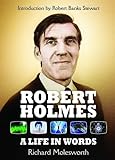
Those who know the work of scriptwriter Robert Holmes will not be at all surprised by the effusive and expansive appreciation in which he is held today by his colleagues, peers, and contemporaries. Whether writing scripts for the far-flung fantasies of Doctor Who or Blake’s 7, or for the more everyday gritty reality of Bergerac, Shoestring, Juliet Bravo or Public Eye, Robert Holmes was one of television’s most innovative, creative, respected – and least lauded – of talents from the ’60s, ’70s and ’80s. Now, for the first time, this book examines his work in detail. For this is Robert Holmes’ life in words.
Doctor Who fans owe the late Robert ‘Bob’ Holmes a huge debt. As writer and Script Editor, he wrote or guided some of the best stories of the classic series between 1968 and 1986, and created or introduced us to Autons, Sontarans, the Master, Jo Grant, corrupt Time Lords, and those are just the headline acts.
When he wasn’t introducing or writing out Doctors and other major characters, or guiding the series with Producer Philip Hinchcliffe, he was fleshing out or entirely rewriting other writers’ work or crafting his own classics. His initial scripts late in the Troughton era were tentative toes dipped in the water of Who, as he grasped the format. However, by his third effort, Spearhead From Space, he was carving a place in TV history and many a childhood nightmare with window-smashing, home-invading Autons. A year later, using the same monster, he managed to traumatise owners of dolls, plastic flowers, inflatable chairs, and even telephones. As well as pushing the limits of violence and horror that were deemed acceptable at the time, a wicked sense of black humour worked its way in too, and became just as much a hallmark of a Bob Holmes script as a grisly death.
After six years of regular contributions, Holmes assumed the role of full script editor just as Tom Baker was cast as the Doctor. With a new Producer and leading man, and the chance to ditch the cosy UNIT trappings of the last few years, Bob’s writing flourished yet further, as he presided over and contributed heavily to four seasons of gothic horror, an element which largely disappeared with him when he left the series in 1977. He continued to write for the show as a freelancer, before a lengthy hiatus, due to variously lack of interest or disagreements with incumbent Producer John Nathan-Turner. Script Editor of the day Eric Saward admired Bob’s work and fought to have him back, but JNT remained opposed for much of Peter Davison’s era, it’s been said he felt insecure and threatened by Bob’s great experience.
Thankfully, JNT finally caved, and Holmes eventually returned to write out Davison in 1984’s The Caves of Androzani, a late classic which is regarded by many as the peak of Who in the 1980s, if not full stop. Bob’s health faded, but continued to write for Doctor Who until his death in 1986, whilst working on the conclusion of The Trial of a Time Lord. His influence can still be felt firmly in the Doctor Who of today, many of his creations have returned, and some of his ‘greatest hits’ moments have been homaged by the showrunners of the current series. He was perhaps the greatest Doctor Who writer that ever lived.
We know his writing, but the man himself is a little more elusive. An inspired world-builder who built up the elements of his scripts in forensic detail. A shy man by some accounts, slightly more bullish and bolshy by others. You can recognise him from the unique voice of his scripts, or the pictures of him with his ever-present pipe, but not so much from the yellowing letters or fanzine interviews due to his self-deprecating nature. Consequently we know him far more from his writing rather than what actually made him tick.
Writer Richard Molesworth cannily combines excerpts from rare interviews with recollections from friends and colleagues to tell a compelling story, as well as the real treat here, a wealth of outlines and scene breakdowns spanning much of his career, drawn from Bob’s own paperwork. These show the master at work. You can’t quite smell the pipe smoke, but this is as close as you’ll get to the man himself by reading about him.
A Life in Words covers Bob’s entire career chronologically, from lying about his age to join the army, through his post-war time as a policeman, to his early days sub-editing and writing short stories for John Bull magazine. These formative experiences led to a break in TV in the late 1950s, and by the time he began writing for Who he already had a strong reputation and a long list of credits to his name. These credits can be slightly exhausting to read, but it gives a strong sense of the writer as workaholic.
He attracted the attention of the producers of The Wednesday Play in 1970, and many of his peers believed that he should be a playwright and winning BAFTAs for his work. Bob didn’t agree, thinking of himself as a hack writer. This lack of self-esteem is sad, but perhaps born more out of pragmatism on Bob’s part, as a freelancer he certainly knew what he was worth, with occasional questions asked about his fees by management. He frequently submitted his own ideas for TV series, but sadly none of these were picked up.
It’s a tragedy that he isn’t spoken of in the same breath as Alan Bennett or Dennis Potter, but we will always have his stories. Now we have his story, a fitting tribute to a giant of Doctor Who, the man who gave the Doctor that second heart.
Robert Holmes: A Life in Words by Richard Molesworth is available now from Telos.co.uk and via the Amazon link below.
|
|
Comments
All opinion pieces and reviews published on this website are the personal opinions of the author and do not necessarily represent the views of this website as a whole.
Any articles based on rumours will come from a variety of sources and may be true, true in part or completely false, they should not be repeated as fact nor taken as anything other than the rumours they are until there is confirmation from official sources.

