As the kids and I settled down to watch Flatline I thought it prudent to warn them that the Doctor might not be in this one as much as Clara. My eight year old boy replied gleefully “that’s good, it means the episode should be more fun.” As I tried to process this odd comment, his younger sister compounded my perplexed state, chipping in with “yeeeesssss not scary.” Apparently they would rather have Clara under their bed than the Doctor (ahh now that connects!), and even after his redeeming actions in The Mummy On The Orient Express they were still struggling to trust the new scary Doctor.
It turns out Flatline is not Doctor-lite at all. The clever device of having him trapped inside his own shrunken TARDIS ensures that he is unable to interact directly with the other characters, except that is through Clara. Capaldi’s scenes are able to be filmed independently from the rest, making this, production-wise, the obligatory Doctor-lite story. But when it comes to plot, Capaldi is very much at the centre of the action. The scary Doctor of the first half of Series 8 is suddenly full of charm and even provides us with a display of heroics as he faces off against the monsters, speaking with a moral authority worthy of even the Tenth Doctor. Indeed by the end of the episode, for the first time questions are asked of Clara, hinting that the Doctor’s concerns about her and Danny Pink are fuelled by much more than jealousy. Refreshingly, my young children were laughing at the Doctor, bringing back memories of bonding with them one Christmas with fish fingers and custard in The Eleventh Hour. And as the credits rolled they confessed that this one was scary as hell.
In a show in which the lead protagonist travels across the dimensions of time and space like some transcendent god, it is surprising how rarely they have been manipulated as part of a storyline. Perhaps writers have considered going down similar routes to Mathieson, but shirked at the difficulties of realising such ideas in the space of 45 minutes on a limited budget. Mathieson boldly tackles the interplay between two and three dimensions, with a sheer boldness reminiscent of the old anti-matter/matter collisions as explored for instance in The Three Doctors and The Planet of Evil. And the effects are sensational even by today’s high standards - looking at the scene in which the policewoman is swallowed up into the floor, we have come a long way from the less impressively realised scenes in The Hungry Earth and Night Terrors.
Mathieson does some interesting things with the TARDIS here, in particular the safe mode, a 3 dimensional equivalent of Windows Safe Mode. Seeing the TARDIS in a form other than a police box makes it as unfamiliar to us as the situation is to the Doctor. The circular Gallifreyan symbols are nicely in keeping with those seen for instance in The End Of Time, but otherwise this is completely new to the viewer and just as the Doctor is excited by facing the unknown, so too the long-termers are excited to see something we have never encountered before about the TARDIS.
From the outset however, it is something of a throwback to Tom Baker and Pat Troughton’s eras when the TARDIS acts all iffy and materialises 120 miles off course. In recent years the Doctor has been a much better pilot, Twelve will blame it on the TARDIS malfunctioning or the alien influence but in reality perhaps he simply gets it wrong from time to time. Overall this mixing of the nostalgic with the new when it comes to the TARDIS is characteristic of the episode as a whole. More like the classic series than any other post 2005 story and yet quite radical in its reversal of roles for Clara and the Doctor
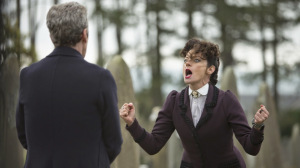
Clara: “I’m the Doctor, Doctor Oswald, but you can call me Clara.”
The Doctor: “you really do throw your companions in at the deep end don’t you.”
Of course Clara relishes the opportunity to call out the doctor for his own questionable methods:
“I’m usually quite vague about (what kind of doctor I am) I pick the title to make me sound important”
“What would the Doctor do next?” she later ponders, concluding he would lie to them, give them false hope. Pleasingly, Clara does not become the Doctor, but relies on her own instincts that turn out to save the day. An early indication that her human thought waves will be of greater use than the Doctor’s intellectual yet alien powers comes in the decisive line “I am the one chance you’ve got of staying alive, that’s who I am” So sympathetic have the viewers (including my children) been led to be towards Clara, that when she asks “what would the doctor do?”, we are already mouthing “what would Clara do?” before she corrects herself.
Social commentary has never been a strong feature of Doctor Who and at times it has been embarrassingly naïve (e.g – the character of Ace in the late 80s and the council estate in Night Terrors) but Flatline tries to make such observations to mixed success. The idea that the police might not invest in an estate in which residents have been written off as worthless is powerful and relevant. The line “no one listening, no one cared” is something that echoes true for many areas of broken Britain. But in reality community regeneration and restorative justice projects are starting to recognise the positive role of graffiti artists, albeit if they are sanitised and consequently a betrayal or watering down of their real power. The idea that a creative wall, one without obscenities would be whitewashed over does a disservice to what really takes place in many cases. That said, the unimaginative and unenlightened community payback boss is a character we can easily identify with. He can be encountered in all walks of life. It is deliciously clever to see the psychic paper fail due to his lack of imagination. In keeping with Mathieson’s Mummy On The Orient Express, the gadget works as a symbiosis of the bearer and victim’s projections.
The character of Rigsy, though performed admirably by Joivan Wade and admittedly a little bit more hard nosed than Sarah Jane Adventures‘ Clyde, was still nonetheless far too lacking in cutting edge. The bleakness of living on that estate should have been represented in his persona, but he was scripted with a lack of anger and passion that potentially could have made it all far more hard hitting. The use of his graffiti art as the resolution to both the Doctor’s trapped plight and the alien beings encroachment upon our world, was predictable yet quite difficult to make sense of. But it at least brings one of the best lines of the episode from the Doctor, who cannot wait to see his next work of art.
The Doctor is strongly moral in his pronouncements at the end of this episode, siding with the marginalised and underprivileged that Rigsy represents. That this is part of the writer’s own stance is clear in other non-Doctor centred parts of the script, such as when the policewoman reasons that the top brass want to cover things up to maintain the status quo. But for Mathieson the Doctor is the hero of the oppressed. Capaldi’s Doctor is following a tradition here that goes back to Hartnell, but one that was especially evident in the Second, Third and Fourth Doctor’s where the common person was frequently empowered by his interventions, whilst the power hungry “lords of the manor” were firmly put in their place. To the Doctor’s chagrin “maybe the wrong people survived.” Certainly the taskmaster fails to receive his comeuppance.
the unimaginative and unenlightened community payback boss is a character we can easily identify with
Visually once again we were in for a real treat, the aliens taking on the human form were particularly effective in their 3D mode, zombies with glitches highlighting that they represent a different type of reality entering our world. The crunching sound of the bones chillingly added to their horror. The 2D mode was not quite as effective and the opening scene of the victims with their backs on the subway walls looked rather too much like men, complete with cross-dressers, lining up in the gents at the local football ground.
The best Doctor Who episodes have been those that intersperse the horrific with the comedic; the realistic with the absurd. The scenes of the shrinking TARDIS and Capaldi’s wonderful reactions to his plight are some of the funniest moments in the show’s history. Combining elements of Alice In Wonderland with Charlie and the Chocolate Factory the miniature door scene was entertaining especially for Capaldi’s awkward postures and freezes. The absurdity of the Adam’s Family moment as the Doctor’s becomes Fingerbobs, was almost Monty Python like. And yet it made great sense and was at no stage sending up the show. The self referential tendencies of recent series inevitably rears its head in the line about saving the cracking of the earth by the TARDIS’ weight for another story, but for the most part the plot is engaging enough to keep us gripped by the immediate dilemmas of the characters.
From time to time a soliloquy of the Doctor becomes part of the mythology of the show, destined to be repeated in compilation after compilation, and we had another one here, brilliantly executed by Capaldi, who very much was his own man in this episode with only the occasional traces of Tom Baker and Pertwee (compared to the more blatant moments of Mummy On The Orient Express). It is a beautiful speech and goes to the heart of what the doctor has always been about, his raison d’etre to fight the monsters:
“I tried to talk. I want you to remember that, I tried to reach out. I tried to understand you but I think that you understand us perfectly and I think that you just don’t care, and I don’t know whether you are here to invade, infiltrate or just replace us, that doesn’t matter now - you are monsters, that is the role you have been determined to play so it seems that I must play mine. The man who stops the monsters. I’m sending you back to your own dimensions and you might not survive the trip but if you do remember this you are not welcome here. This plain is protected, I am the Doctor and I name you…”
Unfortunately, despite repeated reruns I just could not make out the last word. It was a rare moment where the diction of Capaldi against the incidental music is practically unintelligible, but what an awful time to lose it. Such a shame.
But this fist pumping speech is shortly followed by a less than satisfying response to Clara’s efforts to gain recognition “Admit it, I did well…..why cant you say I did good, I was the Doctor and I did good.” “You were an exceptional Doctor, Clara” “Thank you” “goodness had nothing to do with it”. At this point the musical score changes and once again goes all Battlestar Galactica as the scene jumps to Missy presumably in the Neversphere. The combination of music and the brief white light suggests an alternative reality the other side of death and fans of that other franchise will have good reason to see similarity with Kara Thrace’s ambiguous state – is she dead or alive? Friend or Foe? Suddenly from asking questions all series about the Doctor’s morality, we are beginning to reconsider Clara. A rethink not because her anger towards the Doctor in previous episodes was not justified, but because from out of the blue there is now the suggestion that someone is manipulating her. Such over-plotting sadly lessened Amy Pond as a character and it is to be hoped that the wonderfully naturalistic performances of Jenna Coleman will not be compromised by a similar moulding to plot devices further down the line.


Latest News