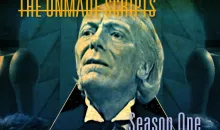
To whomsoever may be interested..
I am the eldest son of the late ‘James Anthony Coburn’, 1927 - 1977. I myself was born in August 1954 and as such, was nine and a bit years old (and already an avid science-fiction reader) when my father excitedly emerged from my parents’ bedroom (which doubled as his study, to where my mother was then serving supper to my next younger brother Francis and myself, saying ‘What do you think of this boys, TARDIS: Time And Relative Dimension In Space?’ I remember being both impressed and excited at the thought of a vehicle so named for being larger on the inside than the outside and being able to travel in time and space.
In the conversation that followed I may even have contributed to Tony’s choice of subject matter for his first ‘Doctor Who‘ story. Mention time travel to any boy of such an age and it is likely (even today) that he will mention dinosaurs and suggest a trip back to the ‘prehistoric era’. Dinosaurs would, of course, as Tony would doubtless at the time must have been well aware, been well beyond the BBC’s ability to convincingly portray, but cavemen would not. I am neither claiming any credit, (or taking any blame) for the story my father settled on, merely allowing that it is likely that my brother’s and my enthusiasm for the idea might have played some part in his decision to proceed with ‘The Tribe of Gum‘.
Tony’s further reports of the progress of ‘Doctor Who’ were both eagerly awaited and met with equal enthusiasm, as were his descriptions of the second story, ‘The Masters of Luxor‘ which he began work on immediately following completion, submission and acceptance of ‘Tribe‘. After a while though, Tony’s answers to questions regarding the progress of ‘Masters’ began to be more vague and dismissive. Nevertheless, when his first episode, ‘An Unearthly Child‘ was screened, the whole family: in order of appearance, myself; eight year old Francis; five-year old Kathleen; four-year old brother Jamie; three-year old Richard, two-year old Michael, together with our overworked mother and Tony himself all sat around the tiny flickering black and white screen, anxiously waiting for the interminable bloody sports results to be over (I still hate anything and everything to do with sports) and the real action to begin. (Our micro-cephalic sister Paula, Joan and Tony’s permanently paralysed, inarticulate and mostly uninvolved third child lay gurgling to herself in a cot in another room. With bloody catholics denied birth-control, my mother proceeded to whelp two more future aspirationally pew-filling brats into the World: Danny in 64 and Joanna in 66 before she finally steeled herself to denying his alleged holiness any more - As much as I hate sports I’ve really got it in for religion of just about any description.
The following week, of course, we had to sit through ‘An Unearthly Child‘ all over again before getting to the second part, ‘The Cave of Skulls‘. Three weeks and the remaining two somewhat anticlimactic episodes later, I was eager to progress, to the first episode of ‘Masters‘ which, from what Tony had told us, I already thought a far more interesting and exciting story. Imagine my disappointment when instead of the opening events he had described, something at first enticingly similar but ultimately quite different from Tony’s story was set before us in the form of Terry Nation’s first ‘dalek’ story. In common with other kids who watched it, I thought the ‘daleks’ suitably scary, of course, and the story involving enough, but a ‘wrong note’ had already been struck and as the weeks went by and ‘Masters‘ failed to put in an appearance, I started to go right off ‘Doctor Who‘. With subsequent stories mostly failing to regain either my interest or my attention. The mystery was left to hang unresolved. Tony never explained (to us small-fry at least) what had happened. I do recall the day he arrived home white with fury at something or other that had happened ‘at work’, and that he would never again willingly even refer to (let alone watch) the series he had only a short time before had such enthusiasm for. If pushed to mention it, he would say as little as possible about it and then only in grudging dismissive tones. The most I could, at the time, get out of my mother was that Tony had ‘argued’ with someone at work about the series and decided that he wanted nothing more to do with it.
For reasons too numerous to enlarge on here (or at least now) as time went on I got on less and less well with my father. I was proud enough of him and his work, at a distance, but did not enjoy spending time in his company. Far from ever being resolved, the rift between us grew and festered over the years to the point that neither of us would eventually do more than grudgingly acknowledge the other. One thing we did later have in common was that we both vastly preferred Gene Roddenberry’s ‘Star Trek‘, when we finally got it in the UK in 1969, as being the ‘intelligent science-fiction show’ that ‘Doctor Who‘ had been originally intended, but then so signally failed to be, but by then our differences had set so severely in that a virtual state of war existed between us. As I became too big for him physically chastise, and took up Taekwondo in loudly declared preference to catholicism into the bargain, he mostly retreated from ritual violence, to habitually entrenched sarcasm in his treatment of me. The last time he physically approached me in anger, I side-kicked him across the room, seriously freaking my mother out in the process.
In 1973 Tony had fulfilled a long-held ambition to produce (and, with Ian Mackintosh, co-create) a series that would, as he once put it, ‘do for the Royal Navy, what ‘Z-Cars‘ had done for the police’. He had no sooner completed production of the first series of this ground-breaking project however than he was laid low by a massive heart-attack which took him away from work for a year, following which he only gradually got back into the swing of things. The experience served to ‘humanise’ him to the extent that my younger siblings now find it difficult to remember him as he was before. He grew a beard, bought a boat, took them all out fishing, and generally became an easier person to live with (and almost like). My relationship with him improved only a little however and then only gradually. It was only when he decided to write his (intended) first (and now only) novel about the captain and crew of a European spacecraft, the ECV Isaac Newton, set in a near space World of the near-future, and actually consulted me for my significantly greater knowledge of some of the issues covered, in the process, that we finally began to talk reasonably to each other, making his death shortly afterwards in April of 1977 doubly tragic for the both of us.
The upshot of all this is that I have lived my life to a significant degree, in Tony’s long shadow. The psychological damage he did to me has crippled and restricted me in ways I am only now beginning to deal with. For many reasons, both positive and negative, I wish he had lived on. For one thing, I have had to contend with the fact that the World in general thought him a fine fellow, which fact has continued to alienate me from pretty well all social institutions in general and so-called ‘authorities’ in particular. Because of Tony’s profound parental incompetence, I quickly became a deeply angry young man and, far from mellowing, have become a much angrier man as I have gotten older. For one thing, if I could push a button and blow Vatican city and every catholic edifice and institution Worldwide to kingdom come, (along with churches, mosques, temples and synagogues everywhere) I would do so joyfully and without the slightest hesitation. In like manner, though for less seriously considered reasons, I profoundly dislike and intensely resent the institution that bloody awful cheesy ‘Doctor Who‘ has become. Its continued existence at all, let alone its modern resurgence, fills me with gall. I refuse to watch it and try, as far as is possible these days, not to even think about it. If I could push a button and do what all the silly ‘daleks’ and even sillier ‘cybermen’ and stupid bloody ‘sontarans’ and the like continue (I’m told) without success to attempt to do and, once and for all kill off the bloody annoying ‘Doctor’ so as to have him disappear entirely from TV screens and schedules everywhere, I would similarly do so cheerfully and without an instant’s hesitation save that necessary to briefly savour the moment.
Despite my declared wish to exterminate (this part at least of) Tony’s legacy, I have perhaps paradoxically become deeply set on understanding his life and work and why he acted as badly as he did. In doing so I certainly have no particular ‘axe to grind’ in advancing either his reputation or his ’cause’. In addition to being my afflictor, now forever beyond my vengeful reach, he remains however, MY father. His works are MY father’s works. His history is MY father’s history. It bugs me, almost beyond belief, therefore to have to read the arrant rubbish that, due to his early involvement in ‘Doctor bloody Who’ rather than in any of the other infinitely more worthy and dramatically satisfying projects he was involved in, has been and still is written about him in one ‘unreferenced’ so-called ‘work’ or another on this or that aspect of that awful childish pap. I contend here, therefore, that unlike any of the various writers and so-called researchers who from time to time, in this publication or that, have presumed to comment, mostly without a shred of verification from anyone who actually knew and lived with him, on my father’s life and work, that I am far more painfully and intimately well acquainted than anyone else, (with the sole exception of my mother) with the subject-matter.
Further to all of the above, in the course of my attempts to get more fully to grips with the events surrounding ‘Tony’s angry departure from ‘Doctor Who‘ in its first ever season, (in support of a possible plagiarism suit against the estate of Terry Nation) I contacted, requested and was granted a one-to-one interview with Verity Lambert, for which purpose I travelled to her home in the summer of 2006; a year and a bit, give or take, prior to her own death in 2007. I spent a very amiable two to three hours or so in Ms Lambert’s company, finding her to be a gracious and entertaining lady full of stories and recollections of her varied and distinguished career, if suddenly and rather unaccountably vague when attempting to recall the precise details of her disagreements (and subsequent out and out collision) with my father.
The closest I was able to get to a definitive statement from Verity regarding the subject of hers and Tony’s disagreement was that she thought that ‘it probably had something to do with religion’. Knowing what I know about him, I’d bet very large sums (if I had large sums to bet) that that is exactly what happened: the catholic zealot (and sexual-chauvinist into the bargain) versus the younger pragmatic Jewess who, to Tony’s no doubt unmitigated gall, outranked him. I have to admit that having myself read ‘The Masters of Luxor‘ on several occasions, I personally have no difficulty whatsoever, taking Verity’s side every time. In her position, I’d have told him to rewrite or get out myself. Whilst, on the other hand, it would certainly have been very ‘bad-form’ for Verity (or anyone else) to pass Tony’s work on to another writer, in the (practically certain) event of his reluctance or even outright refusal to co-operate, I can well understand how an ambitious aspiring young executive trying to fight her way upstream to grab her moment, in a cut-throat, at the time almost entirely male-dominated business, on her first time out at the helm, might have cut a corner or two (if that is in fact what she did) rather than continue to trade theological disputes with Tony ‘the Grand Inquisitor’ Coburn.
To conclude this diatribe for now at least: with all of the preceding having been said, one admittedly backhanded upside to having grown up in Tony’s environment, is that I have, for better or for worse been steeped in his ‘masterclass’ in how to compose stories in general, and how to write for TV and related visual media in particular. Now if I can only recover sufficient self-esteem to stay the course and maintain the ‘head of steam’ required to complete one or more of the numerous writing projects I have at this or that time, with varying degrees of promise begun, even at this late stage of a game I have admittedly mostly missed, I may still, despite Tony as much as because of him, be in with a chance of some kind of Worldly success.
Comments

All opinion pieces and reviews published on this website are the personal opinions of the author and do not necessarily represent the views of this website as a whole.
Any articles based on rumours will come from a variety of sources and may be true, true in part or completely false, they should not be repeated as fact nor taken as anything other than the rumours they are until there is confirmation from official sources.