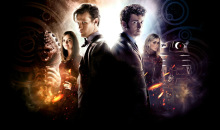
Doctor Who is a series full of scientific wonder and frequently scientific absurdity… Or is it? Physicist Professor Brian Cox aimed to discover the truth behind the science of Doctor Who in last nights lecture from the Royal Institution. Is time travel actually possible? Is the Eye of Harmony actually in the realms of possibility? We were about to find out.
Having seemingly made it his personal crusade to take the science lecture away from the stereotypical trappings of the dusty Oxford don with a whiteboard of doom and equations, Brian Cox has produced a lively and accessible physics discourse and as a bonus provided a few extra glimpses of Matt Smith as the Doctor before his impending demise this Christmas.
Interspersed with sketches featuring both Smith and Cox, the skits show the strengths of our host as an individual willing to bring physics down to the layman’s level, an ability to poke fun both at himself and his subject and make a dry and complicated topic fun for the audience at home. We’d suggest he was the Jamie Oliver of physics, but he might be insulted.. we know we would be.
Filled with celebrity fans, the audience were seemingly left scratching their heads at times but the likes of Rufus Hound (no mistakes this time!) and the quite wonderful Charles Dance were game to get involved in proceedings, using a variety of props to recreate Einstein’s experiments, an effort to prove that time is indeed relative.
Throughout the show the Professor proved that in our own way we are all time travellers and that we could theoretically send a human being into space for a mere ten years and have them return twenty six years later, that we are closer to being able to contact intelligent life than ever before and that the harnessing of a black hole might just be possible, conceding that most scientists agree however that time travel isn’t possible.
Most worryingly however Cox asserted the possibility that alien life could potentially be receiving television signals from Earth, now up to 50 light years away. He has of course ensured galactic war when Ian Levine discovers aliens have Marco Polo and The Daleks Masterplan. Still, might explain where Phil Morris found all those episodes.
A fascinating physics study in its own right, The Science of Doctor Who was a timey-wimey ball of goodness, accessible and interesting to those who are fans of the show and those who aren’t. The addition of Matt Smith was a pleasant bonus and the show marked a fun and intriguing opening to the Doctor Who 50th Anniversary on BBC television.
We might just about be able to to forgive Brian for Things Can Only Get Better after this.
Comments

All opinion pieces and reviews published on this website are the personal opinions of the author and do not necessarily represent the views of this website as a whole.
Any articles based on rumours will come from a variety of sources and may be true, true in part or completely false, they should not be repeated as fact nor taken as anything other than the rumours they are until there is confirmation from official sources.