The Eighth Series of Doctor Who marked a tonal shift within the show from being largely anti-conflict to being pro-military, according to a new article published by the World Socialist Website, part of the Trotskyist International Committee of the Fourth International.
The thought provoking article by Bryan Dyne and Christine Schofelt claims that while the character of Danny Pink is both “troubled by what he has seen and done” and that “he disabuses his students of the idea that war is anything to be glorified or celebrated,” the character’s end in Death in Heaven marks the show’s endorsement of armed conflict, a turn away from the Russell T. Davies years.
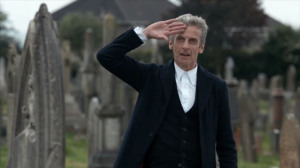
“Danny’s rousing pre-mission speech and his declaration that ‘This is not the order of an officer. This is the promise of a soldier!’ are meant to rally the audience behind the idea of sending in the troops… The scene in which The Doctor salutes a returned UNIT soldier—something he had refused to do in previous years—is a capitulation. For generations, he had not saluted because the military had nothing to offer but destruction. The Doctor’s rejection of aggressive methods and his frequent refusal to cooperate as long as guns were being pointed, his outrage at the needless deaths of even the most bumptious of aliens who had attacked Earth, all this appeared to be a thing of the past as he stood at attention to pay tribute to the Brigadier. Moffat’s aim seems to be to gratuitously knock this hero down, as if to say, peace is all well and good in theory, but when push comes to shove, strike first and shoot. Something about the belligerent mood of the affluent middle class in Britain, the US and elsewhere makes itself felt here.”
Giving examples such as the militarised church of the Smith era and A Good Man Goes to War where “with a cavalier attitude about knocking the enemy out, exploding things and leading an army, The Doctor goes to war,” the article further suggests this tonal shift can be attributed to Steven Moffat:
“The first four seasons of the show advocated a refreshing rejection of violence in general, instead using the abilities, equipment and even the life of The Doctor to save people… In the fifth rebooted season Steven Moffat took over as head writer and show runner after the previous head, Russell T. Davies, stepped down. In considering the Moffat era as a whole, one is forced to reflect on the other works he has overseen, particularly Sherlock. In that show, whatever its strengths (including the participation of Benedict Cumberbatch), the main character is constantly glorified as a “high-functioning sociopath” who goes out of his way to assist British imperialism. Moffat’s Doctor Who episodes reinforce this turn. Far more than previously, they are turned inward. While this inwardness is something the lead character deals with, especially given that he is “the last” of the Time Lords, it has reached an unhealthy level. No longer do the seasons culminate in some great potential catastrophe for humanity that must be opposed and defeated, but rather in some personal problem for The Doctor. One used to feel something beyond a vague voyeurism when watching the season endings of Doctor Who—there was a sense of shared struggle, shared destiny and ultimately hope.”
The full article can be read Here
What do our readers think? has Doctor Who moved away from it’s long-standing message of non-violence? is the series now pro-military or pro-war? were things different during the 3rd Doctor’s era for example? let us know your thoughts via Facebook and Twitter. One for debate!


Latest News