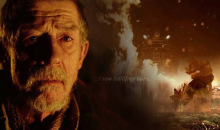
BAFTA Television Craft Award winner Danny Hargreaves of Real SFX has spoken on winning the award for The Day of the Doctor, an award won alongside Milk VFX and the Model Unit who have both equally spoken on their delight at winning the award.
The Cardiff based company won the award in the category of Special, Visual and Graphics Effects for the 50th anniversary special and Danny Hargreaves, founder of the company, has traced the success of the company and his interest in the field back to seeing Terminator 2 as a child:
“I loved that kind of story-telling and filming, after watching Terminator 2 all that was left for me to do was find out how to get into it. I learned my craft directly on the job. I went into work very quickly and I began working on film sets quite young. Over the years I learned special effects. I was fortunate enough to work a variety of different projects from film to TV.”
Since the birth of Real SFX, Danny has been at the forefront of special effects work within the British media industry, providing the effects for films such as Submarine and The Killer Elite, Hargreaves also working on the Star Wars franchise and hits like 28 Days Later and Sexy Beast.
“Like most start-up businesses, I took a step into the unknown, I knew the BBC wanted to develop more dramas in Wales. My career spring-boarded in terms of them. They saw a real opportunity for production in Wales and they made it their ambition to develop that. With their help I started up my own business and it has continued to grow with them.”
Alongside Real SFX’s film work, the company have produced some of the most memorable moments on British TV over the past few years, Danny supervising on shows such as Sherlock, (for which he was nominated for a Primetime Emmy), Torchwood, Coronation Street for the infamous tram crash, Da Vinci’s Demons in the U.S. and of course Doctor Who, for which the company won their BAFTA craft award for the 50th Anniversary special The Day of the Doctor which aired last November. Speaking after the award ceremony, Danny said that the episode was one of the most challenging he’d ever worked on:
“This was one of the most challenging episodes I’ve ever done. It was hugely explosive and action packed, with the added complication of shooting in 3D. I feel truly honoured to have won this award particularly in a year that has celebrated the huge talent in British TV/film making”
The sheer scale of the task involved in producing the special effects for the special can be seen in some of the details of the productions provided by fellow winners Milk VFX and The Model Unit:
Milk created 129 visual effects shots including the dramatic sequences featuring the Gallifreyan city of Arcadia under siege, constructing a large scale 3D environment of the falling city, buildings, debris and explosions; and fly-through shots that fully immerse the audience, taking advantage of the depth that stereoscopic 3D allows, making the sequences more visceral and exciting than ever.
“We worked with Michael Pickwoad the BBC’s Art Director for Doctor Who. The reference we had from the BBC was a classic ‘old master’ oil painting however it looked quite dark. So when we showed Nick Hurran, the Director, our shot of the Gallifrey Citadel he asked us to make the 3D painting look lighter and more like this.”
Murray says that the shot through the painting was one of the most demanding of the team:
“Technically this was one of the most demanding shots, as we were combining elements from the matte painting department, the 3D environment department, and a green screen shoot of the Doctors and a prop model of an exploding Dalek. This was bridged with three full CGI environments of battle-scarred Gallifrey, involving a complex, continuous camera move that stitched together all the separate elements. It was an epic shot for all departments, the shot combined matte paintings, 3D and FX – from smoke plumes, flames and people running, to swarms of Dalek saucers and a frozen explosion on a practical Dalek – a complex composite to make one seamless shot. We also had to integrate smoke and flames which were created in Houdini. The whole thing was rendered out in 3 separate parts in Arnold and composited together in Nuke. After we had assembled all the different elements the shot was re-sped to fit into the edit. The initial concept for this was to be 3 separate shots but we decided to make it more exciting and visceral by making this one long shot.”
Milk also worked with the BBC’s Art Department to design the Dalek fighter pods – a brand new feature of the Dalek fleet – created especially for the 50th anniversary episode to maximize the speed and agility of the Daleks in the attack sequences during the fall of Arcadia as well as creating the space/time portal, which appears throughout the episode as Murray Barber describes:
“It is described in the script as ‘shimmering through the air… howling and crackling’. We see it from several different angles, including looking straight into it. The challenge was to create a real sense of depth within it, both in stereoscopic 3D but also for our 2D viewers. This was quite tricky as the portal isn’t a solid mass, but has a fluid feel about it. The Portal was developed and realised in Houdini.”
Possibly the most memorable special effects seen in the episode however were those centered around Gallifrey and the battle for Arcadia, certainly for fans who have been envisioning the Time War in their minds for many years. Just how did Milk approach the challenges of these effects in The Day of the Doctor?
“For the dramatic sequences set in Arcadia, we created a large-scale 3D environment in Cinema 4D, of the city under siege. Milk designed huge fly-through shots to add a sense of drama and scale as the viewer plunges into the city alongside attacking Dalek Fighter Pods. Milk aimed to give the feel of a city that was near collapse, fighting for survival. The shots are frenetic with lots of explosions and laser fire. The buildings had to stand up to close up scrutiny because of the extreme camera moves. We ended up with around thirty wrecked ‘hero’ buildings that were then instanced (repeated) hundreds of times and the street filled with debris, explosions, fire, crashed saucers and tiny running figures. Working in stereoscopic 3D meant that often we were not able to ‘cheat’ effects and instead had to render smoke and fire in Houdini instead of using pre-filmed smoke and fire elements. As it was in Stereo, it was a great excuse to have lasers flying right past the camera!”
While many of the assets used in the production already existed from previous episodes such as the Dalek saucers, Murray tells of how everything needed to be improved for a potential cinema experience:
“The Dalek saucers were an existing asset which we adapted especially for the 50th anniversary, so that the viewer got closer to them than ever before and made them bigger and better. They needed to stand up to close scrutiny for cinema… The Gallifrey Citadel was [also] an existing asset which we’ve used before, however we improved its textures and geometry as we get closer to it visually and it needed to stand up for cinema. It was created by Simon Wicker our head of Matte Painting for a test and Nick Hurran loved it and wanted to use it which we were very pleased about.”
The Model Unit meanwhile, which was founded by Mike Tucker after the closure of the BBC Effects Department, were utilised during the Time War section of this episode, providing several cutaways of the Time Lord staser cannon (including its destruction) and a longer sequence showing John Hurt’s TARDIS crashing through a wall and destroying several Daleks that are unlucky enough to be in its path.
Following an initial discussion with producer Marcus Wilson to establish the sort of shots that might be needed Miniature Effects Supervisor Mike Tucker met up with stereo supervisors Adam Sculthorp and David Wigram to work through the practicalities of shooting high speed miniature effects sequences in 3D – a first for a British television drama production. A proof of concept test utilising an existing miniature established that the models shouldn’t be smaller than 1/6th scale, and ideally at 1⁄4 scale.
“Further research established that the miniature effects sequences for the Martin Scorsase movie ‘Hugo’ had been done at 1⁄4 scale and with the same Alexa high speed camera rigs that we were planning to use, and so we were able to proceed with a certain amount of confidence that what we were about to do was realistically achievable.”
With a five-week lead-time and a two-day shoot in Cardiff in April of this year model construction was split between several Model Unit regulars. Alan ‘Rocky’ Marshal was given the task of constructing the staser cannon, Nick Kool took on the TARDIS model and associated rigs and Colin Mapson worked with new recruit Paul Jarvis on the ruined Arcadian buildings and breakaway wall sections. In a nod to past effects sequences, the Dalek miniatures were achieved in the time honoured way by utilising off-the-shelf toys (in this case the 18 inch voice- interactive toys that had been produced by Character Options a few years back), albeit with a few careful modifications in order to match them more closely to the actual props. Further detail was added to the interiors, including a scaled model of the mutant creature.
Model Unit DoP Peter Tyler worked closely with main unit DoP Neville Kidd to establishing a lighting design for the miniatures as, due to camera rig availability, we were shooting our miniatures in advance of the live action unit – a complete reversal of how things are usually done. Close collaboration was also needed with the production design team with Mike and assistant art director Richard Hardy constantly swapping notes about the final design details of both Time Lord machinery and architecture to ensure a seamless blend with the location.
Day one of the shoot concentrated on the shooting of the cannon allowing the more complex rig of the TARDIS to be set up and tested, whilst the second day took in several takes of the TARDIS shots. The 1⁄4 scale TARDIS miniature was fixed to a steel rig mounted on a trolley system that allowed us to fire it at the wall using bungee cord.
The talented teams of Real SFX, Milk VFX and The Model Unit deservedly won the BAFTA Craft Award for outstanding special and visual effects on the episode, this being the first year that the British Academy Television Craft Awards have recognised the work of the physical special effects within the award category. The victory at the must have come as a particularly proud moment for a Mike Tucker, having worked on Doctor Who since the Sylvester McCoy era and written a number of novels based on the series.
“It’s a huge honour to win this award in such a competitive category, and I’m delighted that it’s for a programme that showcases just how good collaboration between different effects disciplines can be. On a personal level I’m very proud that a TV show that used to be mocked for the quality of its effects is now leading the field.”
Danny Cohen, CEO of Milk said:
“We are beyond delighted to be recognised by the Academy for our work on Doctor Who. For a company set to celebrate its first year in business at the beginning of June this is a fairytale ending to the year for Milk!”
Danny Hargreaves is in agreement, calling the win “amazing” but praising his team:
“To be nominated was incredible and to win it was amazing, it was one of the most challenging episodes I had ever done. It was hugely explosive and action-packed, with the added complication of shooting in 3D, but it was nice to show my team what is possible if you work hard.”
A huge congratulations once more to all involved in what was a phenomenal production and clearly a huge undertaking. You can watch the proud moment from the BAFTA craft awards once again via the video below.


Latest News