
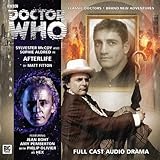
Hex is dead. And a distraught Ace holds the Doctor responsible. She forces him to take a trip to 21st century Liverpool to break the news to Hex’s beloved nan and, to pay tribute to Thomas Hector Schofield, the pair seek out his family and friends to tell them of his adventures. They’re helped by Private Sally Morgan, who has her own peace to find. The Doctor, Ace and Sally must each face the fallout of the loss of their friend - to commemorate him, remember him, and finally to move on. But can they do it together, or will their attempts drive them apart?
Afterlife is a play that is almost two audios in one, the first episode set completely in the TARDIS and set almost separate to the other three episodes of the story. It is episode one in particular that shows how far the series has developed at the emotional level when contrasted to the quick brushing aside of the death of Adric in the 1980s. Sylvester McCoy and Sophie Aldred rise to occasion magnificently as Ace takes Hex’s death understandably hard and this may well be Sophie’s finest performance in the role. Intense, raw and raging at the Doctor, it is as far as Ace has come from the Nitro 9 loving teenager from Perivale.
The Dark Doctor of Season 26 onward had become something of a cliche in many ways to the point that betrayal and subterfuge are expected of him, that the drama and shock of revelations attributed to him have lost something of their impact and Ace’s shock seems almost misplaced. With Big Finish and famously The New Adventures before them using the character so prolifically, there was the danger here that Afterlife could have become all too familiar, but here it is Ace turning the tables, forcing the Doctor to face the consequences of his meddling.
McCoy too is at his best here, his pain at losing first Hex and now potentially Ace is brought across wonderfully and his final speech is something to behold, one of the standout McCoy moments from the company as the Doctor echoes David Tennant’s Time Lord victorious in The Family of Blood and The Waters of Mars. As he begs for forgiveness on the one hand, the pain and concept of being alone seems at times to push him further toward being the Dark Doctor that has caused the problem. Is the Doctor a God or a monster? the play asks the questions of the Doctors infallibility, of the faith that Ace placed in him never to fail and as he fails time and again, the answer is a shocking one. He is certainly not a God.
The play deals with one of the often neglected issues of the time travel concept, that everyone the Doctor has every liked and loved is at the push of a button long dead, never born and still alive and well. It’s powerful stuff as you remember just how old the Doctor really is, how many lives he has led and how many others he has seen die before his eyes. The lives of mortals are specks on a timeline to a Time Lord, the life he leads doesn’t allow mourning.
Afterlife is a quality script from Matt Fitton that handles the drama of Hex’s death and return in a real and genuine way, writing an intelligent drama all about the true meaning of being human that asks questions of both the central characters. Afterlife is perfectly constructed as a bridge of sorts between the Elder Gods arc and what is to come when this TARDIS team returns, an epilogue and a preview. Yet the survival of “Hex” has the potential to be seen as something of a cheap reset switch going into the next seventh Doctor arc which begins this month.
Whatever development and drama that may have come from the death of Hex is cheapened by his return to life via the Powers That Be, his resurrection serving to dampen the sacrifice and the play’s own opening episode. Direct comparison can be made with the fate of Charley Pollard and the return of the survived Adric in The Boy That Time Forgot, both in direct comparison to the shocking death of Lucie Miller in To The Death. There can’t be an true emotional advancement for either the Doctor or Ace while Hex continues to “live” but that is surely the point of the arc as Ace, who insists she’s “moving on” is doing no such thing and future conflict with the Doctor over a Hex who is no longer there seems inevitable. As the question is asked of who Ace herself has become, of whether she has travelled too long with the Doctor, one arc ends another begins with burning questions waiting to be answered.
Afterlife is undoubtedly best in it’s opening episode, a play that deals with weighty questions and gives a quite shocking answer, one of real feeling, emotion and drama. While there are reservations about the return of Hex, the TARDIS trio has been an enjoyable one and further stories are not unwelcome, particularly with a potential new dynamic between the three. Afterlife acts both as an ending and a beginning as we lead into Revenge of the Swarm and is another recommended adventure from Big Finish.
Written By: Matt Fitton
Directed By: Ken Bentley
Cast: Sylvester McCoy (The Doctor), Sophie Aldred (Ace), Philip Olivier (Hex), Amy Pemberton (Sally Morgan), Jean Boht (Hilda Schofield), Mandi Symonds (Lily Finnegan), Jonathan Forbes (Barry Finnegan), Andrew Dickens (DI Derek Mortimer)
Afterlife is available now from BigFinish.com or via the Amazon link below.
|
|
Comments
All opinion pieces and reviews published on this website are the personal opinions of the author and do not necessarily represent the views of this website as a whole.
Any articles based on rumours will come from a variety of sources and may be true, true in part or completely false, they should not be repeated as fact nor taken as anything other than the rumours they are until there is confirmation from official sources.


