



The Doctor and Romana are in Paris, enjoying the culture and art. However trouble is not far behind, just what are the Count and Countess Scarlioni up to and what are their plans for the Mona Lisa? What is causing the time distortions that the Doctor and Romana have felt? And just who is this chap Duggan, and what is his role in all of this? All will be revealed in the ‘City Of Death’.
So where do we begin? Although the writer of this is ‘”David Agnew”, it is in fact a pseudonym for David Fisher (original idea), Graham Williams (producer) and Douglas Adams (God) and it is the last one, Douglas Adams, who really shows his comic sci-fi writing that we all would come to love in The Hitchhiker’s Guide To The Galaxy. After a poor season opener with Destiny of the Daleks, with a script that Terry Nation had phoned in on a bad line, Davros now speaking with more of a Scottish accent then the Dalek-esq vocal harmony that Wisher had given (Watch the clip of Davros saying ‘Davros Lives!’ and hear what I mean), and a case of Daleks that looked more like a kid had made them for a Blue Peter special then the gleaming bad ass machines from the previous story (as you can gather, Destiny may not in fact be my favourite Dalek story, but seeing as Day of the Daleks happens to be that story, what do I know?), City Of Death comes out of this bad patch to bring something to Doctor Who that had been missing for a while - the right combination of comedy and horror.

Original VHS cover, 1991.
So a quick rundown of the story. City starts with a landscape shot of an alien world, but is in fact Earth in the distant past, and a spaceship attempting to take off. Scaroth (the pilot with a face that looks as if someone put a lot of green spaghetti over his head with a meat ball in the middle) tries but fails, and the end result is the ship exploding into little pieces. Anyway we catch up with the Doctor and Romana (in that School Girl outfit we all love…. , but the major difference here is we are not in some Devonshire quarry, oh no, the BBC have spent some money on the program and shipped the crew to a small place in Europe known as Paris. With wonderful shots of Tom and Lalla walking around the Parisian streets, we get to the story in a small café, the Doctor and Romana feel the effects of a ‘time distortion’. Deciding to go to the Louvre to look at one of the ‘great treasures of the universe‘ the Mona Lisa, they run into Duggan, who is tailing the Countess Scarlioni . Much hi-jinks later, and the three are taken the to Count and Countess home, to discover that there are six Mona Lisa’s bricked up and awaiting to be sold once the real one is stolen. But this hides the true intention of Scarlioni, to fund his time travel experiments, and not the way of producing food, but as a means to get back in time to the spacecraft explosion and stop it from happening. The Doctor must stop him at all costs as this means that life on the Earth will be lost, for it was the explosion that caused life to form on this planet. To cut a long story short, the Doctor finds out that Scarlioni is in fact Scaroth, who is splintered through time and using a mental link to each version of Scaroth to plan his deed. Needless to say, the Doctor manages to stop the plans of Scaroth, and make sure that history is on its true course.
So what can I say about the City Of Death. I cannot lie, it ranks as one of my top five Doctor Who stories of all time as it manages to combine a top acting cast, with Tom Chadbon as a superb casting as Duggan, the bumbling private detective with a habit for punching first, asking questions later. There is are the Count and Countess Scarlioni, played by Julian Glover and Catherine Schell. Both bounce off each other as a believable villainous couple, but it is Glover who brings a double edged side to Scarlioni/Scaroth that is a charm to watch on the screen. Even Tom Baker & Lalla Ward are on top form as the Doctor and Romana as they begin their onscreen (and later off-screen) partnership. But my favourite actors in this story happen to only have a cameo. John Cleese and Eleanor Bron as the two art gallery visitors bring an amusing moment of surreal humour to the show, discussing the artistic nature of the TARDIS, yet neither playing the part for a cheep laugh, but both for their moment on screen, making a believable couple who think that the TARDIS dematerialising is just part of the artists show (and having been to art shows, I could see why)
2001 VHS Re-Issue
But it is down to the man who wrote City Of Death, Douglas Adams, as to why this is in my top five, and in the top five of many in fandom. Although he is often taken to task for adding too much ‘joke humour’ into the show, it is not just down to him for this as there was pressure from the top to lighten the show after the Hitchcliffe/Holmes Gothic Horror era of the mid 70’s. Adams managed in his story to inject what the show needed, that of a comedic streak but with the seriousness needed to pull it off. Douglas Adams gets a lot of stick in fandom for making the show too jokey during his tenure as Script Editor, but it was not down to him along as there are many factors that add to the change, including Tom himself, but it is stories like City that show humour can be used at the right times, something that we wont see that much in the JNT era of Doctor Who, and doesn’t come back to Doctor Who properly until the new series, though Love & Monsters (A story that I hate with a passion) took it too far, anyone who states that the Douglas Adams era was to jokey should watch that and see he was being far more serious.
City of Death would be the last time that Doctor Who would have a true ‘Classic’ in any sense until the end of Season 18 with Logopolis, and stands out as a classic in the 48 years of the show. What makes City Of Death a joy to watch is that all of the hallmarks of a classic story, that of good writing, casting, directing, and acting, all to be seen here, along with shots of Paris that add to the stories flow, and not detract from it like on other occasions where location filming in other countries has been used (Such as The Two Doctors). In the end I have to give this story my second 10 out of 10 for the fact that it is to this day one of the best Tom Baker stories out there, and ranks as of the top five stories in the history of the show.
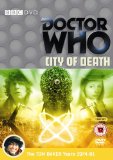
City of Death was originally broadcast between September 29 and October 20 1979 as the second serial of Doctor Who‘s seventeenth season. It was released on VHS in July 1991 and reissued in May 2001. It was released on DVD in November 2005, available from the Amazon link below. City of Death was novelised this month by James Goss, our review which can be found Here.
The Doctor (Tom Baker) and Romana (Lalla Ward) visit Paris for a holiday. When the Mona Lisa is stolen, the Doctor comes upon evidence of sinister time experiments being carried out by a wealthy Count, Scarlioni. He soon exposes a plot by Scaroth, the last of the Jagaroth race, to re-write the history of Earth by avoiding the destruction of his space ship - but it was this explosion that led to the formation of life on Earth! DVD Extras: Commentary - with stars Julian Glover, Tom Chadbon and director Michael Hayes 'Paris, W12' - behind the scenes featurette Studio featurette - recently discovered behind-the-scenes footage from the making of the story 'Prehistoric Landscapes' - montage of unused landscape and spacecraft model shots from the story 'Chicken Wrangler' - comedic montage of the trials and tribulations of trying to film the chicken sequence 'Eye on Blatchford' - spoof investigative documentary from the team who bought us 'Oh Mummy'! We enter the life of one of Blatchford's more unusual residents... Sardoth, the second-to-last of the Jagaroth! Photo Gallery - rare and previously unseen photos and production designs 1980 Doctor Who Annual - PDF format version of the complete annual for PC/Mac Production Subtitle Notes Original 'Next Week' caption and continuity voiceover from end of part four 3 Easter Eggs
| ||||||||


Leave a Reply